GEO Content Optimization
GEO content optimization improves your existing pages so buyers and AI search tools can understand what you offer and why it fits.
Your best material may already exist in client work, LinkedIn posts and sales conversations. I turn it into useful service, product and comparison pages. The work starts with the buyer’s decision and the proof you can actually show.

From a vague promise to a useful answer
Illustrative editing example. Bracketed details must come from your business before publication.
| The weak copy | What the buyer still needs | What the rewrite should include |
|---|---|---|
| “We offer complete marketing solutions.” | What do you actually do? | Name the service, the customer and the work included |
| “Trusted by leading companies.” | Why should I believe that? | Use a named, approved testimonial or a documented example |
| “Contact us to learn more.” | What happens after I enquire? | Explain the first step and what to send |
Keep the useful page. Fix the missing answer, unclear offer or buried proof before commissioning another article.
GEO content optimization services for pages that already matter
I work on pages that help someone choose: service pages, product explanations, comparisons and useful answers close to that decision. If a page already ranks or earns enquiries, I preserve its useful content and history while fixing what is missing.
This is a scoped editing and implementation service. We agree on the pages, the business facts and the changes before I start. You get revised copy and, where included, the work to put it on the website.
A rewrite cannot make a weak or unproven offer trustworthy by itself. If the page lacks a real example, a clear service description or permission to use a result, that is an input we need to fix. I will not fill the space with a made-up claim.
First, choose which content deserves the work
A page is worth improving when it matches a real buyer question and your business can give a better answer. I look at the current page, the search results and the next step you want the visitor to take. More words are not automatically the missing piece.
A service page with traffic but few enquiries may need clearer scope or a better form. A comparison page may omit the difference customers actually ask about. A detailed guide may answer the question well but give the reader no route to your service.
I also check for competing pages on your own site. If two URLs do the same job, the right answer may be a combined page and clearer links. Creating a new version of the same article would make that problem worse.
The rewrite starts with your offer and your proof
I use your existing material to find the details only your business can provide. That might be a customer question from a sales call, a public LinkedIn post, an approved testimonial, original photos or a documented piece of work.
Then I write the answer plainly. What do you do? Who is it for? What happens first? What should a buyer compare? The page should answer those questions before asking someone to book a call.
You review the claims and the wording before the page goes live. I keep an eye on what cannot be said as well: private client information, unsupported results and expertise the business has not established. Search-friendly copy still has to be true.
Clear answers that can stand on their own
AI search tools may use a passage rather than an entire page. I make important answers understandable without relying on a distant heading or an unexplained “we.” A short paragraph should identify the subject and explain the useful detail.
For a service page, that means saying what the service includes and when it makes sense. For a comparison, it means explaining the tradeoff. For a product page, it means making specifications, fit and limitations easy to find.
I use headings, tables and FAQs where they help a reader scan. I do not turn every sentence into a bullet or repeat a phrase just to make the page look optimized. Your voice and the customer’s question set the structure.
Content, technical SEO and structured data work together
Once the human draft works, I check the search coverage. The title, main heading, description and supporting sections should make the subject clear. Missing concepts belong in useful explanations, not a block of keywords at the bottom.
Where the agreed scope includes site changes, I check the rendered page, links, images, mobile layout and relevant structured data. Markup should describe the visible content. It is not a substitute for proof and it does not guarantee an AI citation.
Google’s guidance on AI features and websites is a useful reference: the established search foundations still matter. I keep the page accessible and useful rather than sell a secret AI-only file as the whole solution.
What generative engine optimization means for your content
Generative engine optimization is the industry term for improving how a business can be understood and represented in AI-generated answers. GEO content work is the page part of that job. It deals with the offer, the facts and how clearly they are explained.
Traditional SEO often starts with a list of search engine results and the page a person clicks. Generative engines can compose an answer using several sources. Your content may inform the answer without becoming the recommended provider, so a citation and a sale remain different outcomes.
There is overlap between SEO and GEO. Both depend on content quality, factual accuracy and pages that can be found. I optimize content for the human decision first, then check whether the relevant search systems can access and understand it.
How to structure your content without flattening your voice
Start with the question the page is meant to answer. Put the answer near the top, then explain the details that would change a buyer’s decision. A service page needs a clear offer. A comparison needs genuine differences. The structure follows the job.
A useful FAQ covers the questions people still have after reading. I avoid adding a long set of near-identical questions just to repeat the service name. Tables are helpful when a reader needs to compare scope, fit or the next step.
When I structure content for AI search, I preserve names, qualifications and sources that make the answer specific. Shortening a paragraph should not remove the condition that makes a claim true. That is especially important with client results.
Google AI Overviews, AI Mode and other AI tools
Google AI Overviews and AI Mode are part of Google Search. Google says the usual SEO best practices remain relevant and that no special schema is required for those features. I use that guidance when deciding which technical additions are worth doing.
Tools like ChatGPT and Perplexity have their own products and source-selection behaviour. I do not assume an edit that helps one AI answer will produce the same answer everywhere. We agree on which observations will be used to review the work.
Generative AI models can also misread or repeat old information. Clear dates, named sources and accurate service descriptions help the reader verify the page. They do not give us control over an outside AI system.
Update content when the business facts change
Content freshness should reflect a real change. A new offer, a retired service, updated specifications or an approved case study gives you a reason to update content. Changing a date without changing anything useful does not help a customer.
I check related pages when a core fact changes. If the service page says one thing and an older guide says another, the rewrite has left a trust problem behind. Links, captions and relevant structured data should agree with the updated copy.
Your content strategy should also decide what to stop publishing. High-quality content is not a quota. When an existing page already answers the question, improving it may be a better use of the budget than creating a second article.
Original evidence beats generic content for AI
A public LinkedIn post can contain a useful lesson from real work. A client screenshot can show what changed. Original photos can show who does the job. I use these only when they belong to the business and can be published with the right context.
User-generated content can reveal questions and objections that a polished competitor page misses. It is useful research material, not automatic proof that the claim in a forum post is true. Technical claims still need an authoritative source.
I do not create content by copying a competitor’s outline and swapping the name. The page should contain something a buyer could not get from every other result, such as a worked example, an honest comparison or a detail from your actual service.
What this service does not include by default
Writing and implementing agreed pages is different from ongoing promotion, paid advertising or a broad technical rebuild. If the page needs those things, I explain the extra scope. You should know which part of the job you are buying.
A missing mention can come from the sources outside your website. If your pages are already clear, more editing may not be the priority. An AI visibility audit can help separate a page problem from a wider reputation or discovery problem.
For a combined program, see my answer engine optimization services. For repeat measurement after a rewrite, choose AI visibility tracking services. Each has a different purpose.
Why work directly with Zechariah Tokar?
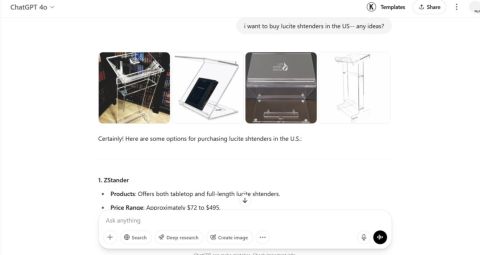
I do the research and the page work myself. My published ZStander example shows work across indexing, page clarity and supporting search foundations. It is an organic search example, not proof that a particular rewrite guarantees a citation.
I care about what a visitor does after reading. A paragraph can cover every search term and still leave the buyer wondering whether the business is right for them. I want the page to make that decision easier.
Send the URL you want improved, the offer it should sell and any proof you are allowed to publish. I will review whether an edit, a fuller rewrite or a different page is the sensible starting point. Fees and responsibilities are agreed before work begins.
Let’s make the scope clear.
Is GEO content optimization different from SEO writing?
They overlap. Both need useful answers, clear page structure and a site that search engines can access. This service focuses on improving existing commercial pages for buyers and AI-assisted research. I do not charge for two identical rewrites under different names.
Can you use my LinkedIn posts and existing content?
Yes. Your public posts, approved client examples and other owned material can make the page more specific. I check the source and adapt it for the website reader. I do not treat every post as permission to publish private client details.
Will you publish the changes on my site?
Implementation can be included in the agreed scope, depending on your platform and access. We confirm which pages change, who approves the copy and what gets checked before publication.
Do we need to replace all our content?
Usually the starting point is a focused group of pages. Keep what is useful, preserve working URLs and fix the part that prevents a buyer from understanding or trusting the offer. A site-wide rewrite needs a reason.